Creating a Recovery Partition in Windows
Step-by-step guide to shrinking the Windows partition, creating a 1.5 GB recovery partition in the correct disk position, and re-registering WinRE with reagentc.
Creating a Recovery Partition in Windows
TLDR: Shrink the Windows partition using GParted or MiniTool, create a 1.5 GB recovery partition in the freed space using
diskpart, then re-register WinRE usingreagentcfrom within Windows.
Why bother?
By default, Windows sometimes places the recovery partition at the end of the disk, or omits a proper one entirely after certain upgrade or clone operations. The correct layout — EFI → MSR → Recovery → Windows — ensures that WinRE (Windows Recovery Environment) is accessible even if the Windows partition is damaged, and makes future partition resizing cleaner since the recovery partition won’t be stranded at the end of the drive.
This guide assumes you have a medium level of comfort with disk tools and the command line. You will be working with partition operations — back up your data before proceeding.
Overview of the Process
- Backup WinRE - Backup the
Recoveryfolder to a safe location. - Disable WinRE from within Windows so the recovery partition is not locked.
- Shrink the Windows partition using GParted or MiniTool Partition Wizard (bootable USB), freeing 1.5 GB immediately before the Windows partition.
- Create and configure the recovery partition using
diskpart. - Re-enable and re-register WinRE using
reagentc. - Cleanup - Remove the drive letter R.
Target Partition Layout
| # | Type | Size |
|---|---|---|
| 1 | EFI System Partition | 500 MB |
| 2 | Microsoft Reserved (MSR) | 128 MB |
| 3 | Recovery (WinRE) | 1.5 GB |
| 4 | Windows (C:) | Remainder |
| 5 | Data / Other | (if applicable) |
The Process
Step 1 — Backup the WinRE Recovery folder to a safe location.
from diskpart assign the Recovery Partition a drive letter
Assuming our Recovery partition was partition 4 in Windows
1
2
3
4
5
6
diskpart
    list disk
    select disk 0
    list partition
    sel part 4
    ass letter R
Browse to the partition and backup the Recovery Folder
You may need to unhide system and hidden folders and backup the Recovery folder which will have the Winre.wim file within it to somewhere in the Windows Partition
Step 2 — Disable WinRE (run as Administrator in Windows)
Before touching partitions, disable WinRE so Windows releases its lock on the recovery partition.
1
reagentc /disable
Verify the status:
1
reagentc /info
WinRE status should show Disabled.
Step 3 — Shrink the Windows Partition (GParted or MiniTool)
Boot from a GParted Live USB or MiniTool Partition Wizard bootable USB.
- Select the Windows (C:) partition.
- Shrink it by 1536 MB (1.5 GB), placing the freed space before the Windows partition (i.e., to the left in the visual layout).
- Create a new partition in the freed space with the following settings:
- Type: Primary
- Size: 1536 MB
- File System: NTFS
- Boot Flag: Off
- Apply the operation and reboot back into Windows.
Make sure the freed unallocated space lands between the MSR partition and the Windows partition — not at the end of the disk.
While you are at it, it’s much easier to create that partition from Gparted or Minitool Parition Wizard
But we will the commands below just in case
Step 4 — Create the Recovery Partition (diskpart)
Open Command Prompt as Administrator and launch diskpart:
1
diskpart
1
2
3
list disk
select disk 0
list partition
Note the partition number of your Windows (C:) partition and confirm unallocated space is visible before it.
Create and configure the recovery partition:
1
2
3
4
5
6
7
8
diskpart
  create partition primary size=1536 offset=643072
  format quick fs=ntfs label="Recovery"
  set id=de94bba4-06d1-4d40-a16a-bfd50179d6ac
  gpt attributes=0x8000000000000001
  list partition
  ass letter=r
  exit
The GUID
de94bba4-06d1-4d40-a16a-bfd50179d6acis the standard Windows Recovery partition type.
The GPT attribute flags mark it as required and hidden.
The meaning of the GPT Attributes:
0x8000000000000000: Hidden and No Drive Letter.0x0000000000000001: Required partition.0x8000000000000001: Combined: Required, hidden, and no drive letter.
Copy back the Recovery folder previously backed up
Step 5 — Re-enable WinRE and Register the New Partition
Back in an elevated Command Prompt:
1
2
3
reagentc /setreimage /path R:\Recovery\WindowsRE /target c:\Windows
reagentc /enable
reagentc /info
A successful result looks like this:
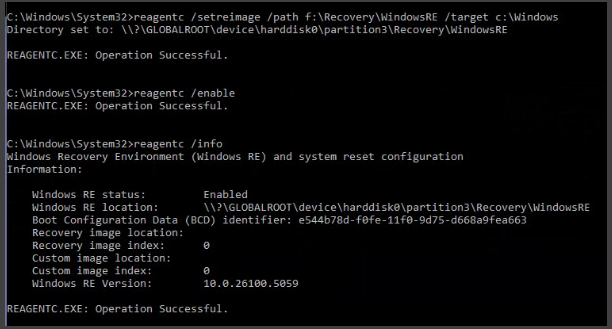
WinRE status should show Enabled and the path should point to the new partition.
Step 6 — Cleanup (Remove Drive Letter)
At this point we can remove the drive letter R: from showing up in the system.
1
2
3
4
diskpart
  sel vol r
  remove letter=r
  exit
Prevent the drive mount from showing up in the system.
From an elevated Command Prompt:
1
  mountvol /R
Quick Reference — Commands Only
Step 1 — Backup andDisable WinRE
1
2
3
4
5
6
diskpart
    list disk
    select disk 0
    list partition
    sel part 4
    ass letter R
Copy the Recovery folder from R: to a safe location.
1
  reagentc /disable
- Remove the Recovery partition from the system.
- Resize the Windows partition to make room for the new Recovery partition.
- Recreate the Recovery partition with the correct size and attributes.
Step 4 — diskpart Create the Recovery Partition
1
2
3
4
5
6
7
8
9
diskpart
  list disk
  select disk 0
  list partition
  create partition primary size=1536 offset=643072
  format quick fs=ntfs label="Recovery"
  set id=de94bba4-06d1-4d40-a16a-bfd50179d6ac
  gpt attributes=0x8000000000000001
  exit
- Copy the Recovery folder from the backup location to the new Recovery partition.
Step 5 — reagentc Re-enable WinRE
1
2
3
reagentc /setreimage /path R:\Recovery\WindowsRE /target c:\Windows
reagentc /enable
reagentc /info
- Reboot to test
Step 6 — Cleanup
1
2
3
4
5
diskpart
  sel vol r
  remove letter=r
  exit
mountvol /R
Troubleshooting
- reagentc /enable fails — confirm the partition type GUID and GPT attributes were set correctly in diskpart. Run
list partitionand verify the recovery partition exists. - WinRE path points to wrong location — use
reagentc /setreimage /path <path>to manually point it to the correct partition if auto-detection fails.
This is a personal reference guide. Always verify partition numbers on your specific disk before running destructive commands.
© 2026 Michael Schmitz
This work is licensed under the Creative Commons Attribution-ShareAlike 4.0 International License.
You are free to share and adapt this work with attribution. Derivative works must be distributed under the same license.